A Scalable Digital Government Infrastructure for one of Victoria's Most Diverse Communities
2016

Overview
I led the UX strategy and research for the City of Yarra's digital transformation, designing a future-proof suite of accessible, mobile-friendly council websites serving one of Melbourne's most culturally diverse communities. Through extensive stakeholder research and a strategically designed, scalable information architecture framework, we delivered a comprehensive solution that serves both residents and council staff whilst building the council's capacity for ongoing digital evolution.
Context
Yarra City is a vibrant inner-city municipality positioned in the north and east of Melbourne's Central Business District. This community's members come from an extraordinarily broad range of backgrounds – from newly arrived immigrants with English as a second language, to young professionals enjoying an inner-city lifestyle, to art-loving retirees who have recently downsized.
The City of Yarra's suite of websites had been expanding over the years as its services to the community had grown. The council recognised this was unsustainable and that a complete digital overhaul was required, including a new content management system. This wasn't just a technical problem – it was a strategic challenge about how local government delivers services to increasingly diverse, digitally connected communities.
Our challenge was to craft a suite of highly accessible, future-proof websites that made both internal and community users' lives easier when engaging with the City of Yarra. This meant designing for incredible diversity – not just in demographics, but in digital literacy, language proficiency, needs, and expectations. A newly arrived refugee looking for community services needed to navigate the same system as a property developer seeking planning permits.
The strategic complexity went deeper. Local councils face unique challenges: they serve everyone in their municipality (you can't choose not to use council services), they deliver hundreds of different services (from waste collection to planning permits to community programs), and they must balance efficiency with accessibility. Unlike commercial digital products that can optimise for their core users, councils must genuinely serve everyone – including those least comfortable with digital services.
Furthermore, council services constantly evolve. New programmes launch, regulations change, community needs shift. Any digital solution needed to accommodate this evolution without requiring expensive, disruptive redesigns every few years. This required thinking strategically about scalability and flexibility, not just immediate user experience.
Approach
To understand such a complex task, I advocated for spending a significant portion of the project budget and timeline in the discovery stage, researching the City of Yarra's many stakeholders and users. This wasn't standard practice – councils often want to rush to solutions – but I made the strategic case that without deep understanding of diverse user needs, we'd build something that failed the people who needed it most.
Following a heuristic review of the current site, we conducted intensive workshops and surveys with various user groups to gather all the information we needed and began synthesising it. My approach involved engaging front-line staff, department heads, elected councillors, and diverse community members to build a comprehensive picture of how the council's digital presence needed to serve multiple stakeholders.
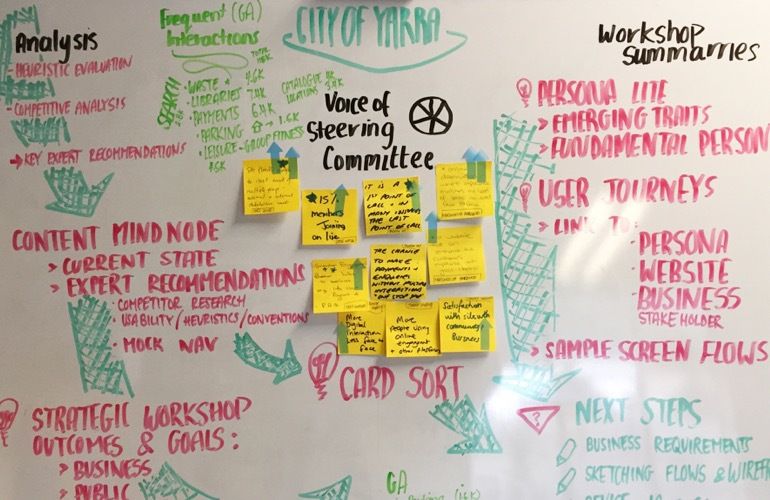
The research revealed the true scale of the challenge. Different user groups had fundamentally different mental models of how council services should be organised. Some thought by life events (having a baby, moving house), others by service type (waste, permits, community programs), and still others by location (my street, my suburb). The existing sites had grown organically, creating silos that made sense internally but confused residents.
We mapped user journeys for diverse personas – from the elderly resident needing to report a footpath issue to the small business owner applying for an outdoor dining permit. We identified common pain points: difficulty finding the right service, unclear next steps, forms that weren't mobile-friendly, and language that assumed too much prior knowledge.
Critically, the research surfaced something that shaped our entire strategic approach: the edges aren't edge cases in Yarra. The person who struggles with English, the elderly resident who isn't digitally confident, the small business owner navigating complex regulations – these weren't outliers, they were significant segments of Yarra's community. Any solution optimised for "typical users" would fail too many residents.
This insight led to a strategic decision: design for the edges first. If we could make the system work for the most challenged users, it would work brilliantly for everyone else. This principle – designing for the edges – became the foundation of our approach.
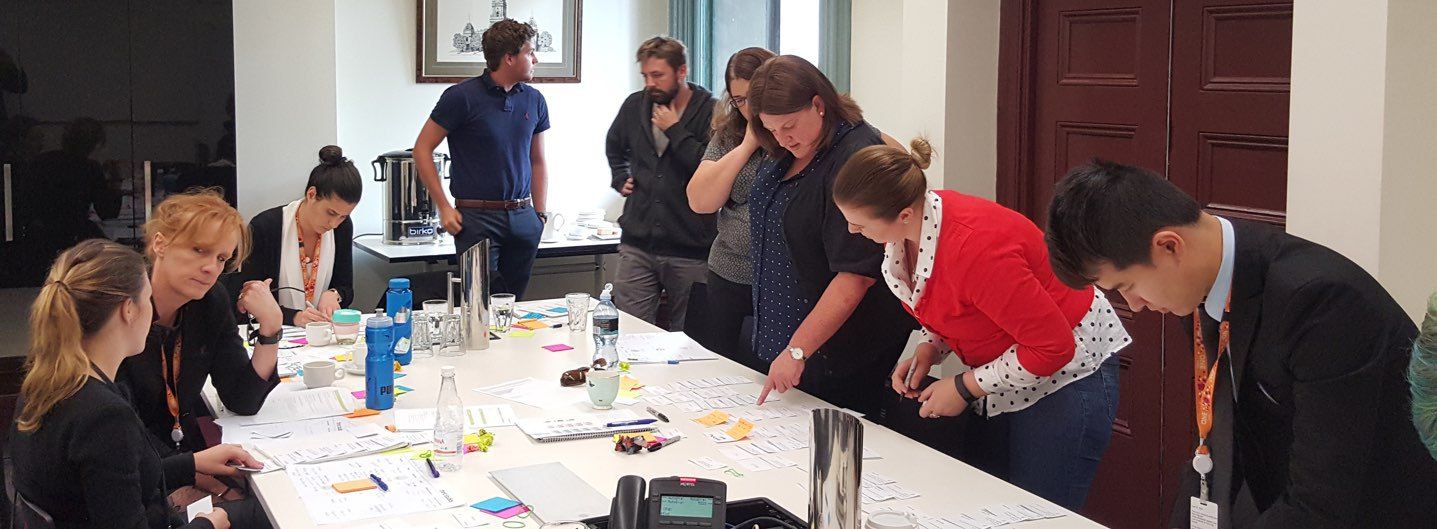
Only once we had a thorough understanding of the City of Yarra ecosystem would we then sketch, test, and design our way through to a comprehensive solution. The initial research stage also included gathering technical requirements that informed the selection of a recommended CMS capable of supporting the scalability and accessibility requirements we'd identified.
My role involved not just conducting research and designing solutions, but building the council's strategic understanding of why this approach mattered. I worked to shift thinking from "we need a new website" to "we need digital infrastructure that can evolve with our community's changing needs."
Outcome
Because of the wide-reaching research and design phases, we confidently delivered a suite of customer-facing websites that were accessible, mobile-friendly, consistent, and above all, usable for Yarra's diverse community.
We developed an information architecture framework that was genuinely scalable, designed to accommodate future services and changing community needs without requiring fundamental restructuring. The IA supported multiple pathways to the same content, acknowledging that different users would approach council services from different angles. This flexibility was a strategic asset, not just a design feature – it meant the council could add new services, reorganise departments, or shift priorities without the digital architecture breaking.
Our deliverables included comprehensive user personas, journey mapping, user surveys, wireframe designs, and UI design that balanced the council's need for consistency with the diverse community's need for clarity and accessibility. We provided detailed documentation to support the development handover, ensuring our strategic decisions and design rationale would be properly implemented and could guide future iterations.
Critically, we also built the council's internal capability. Through workshops and collaborative design processes, council staff developed better understanding of user-centred design principles and how to make decisions that served diverse community needs. This capacity building was strategic – the council would need to maintain and evolve the platform long after our engagement ended.
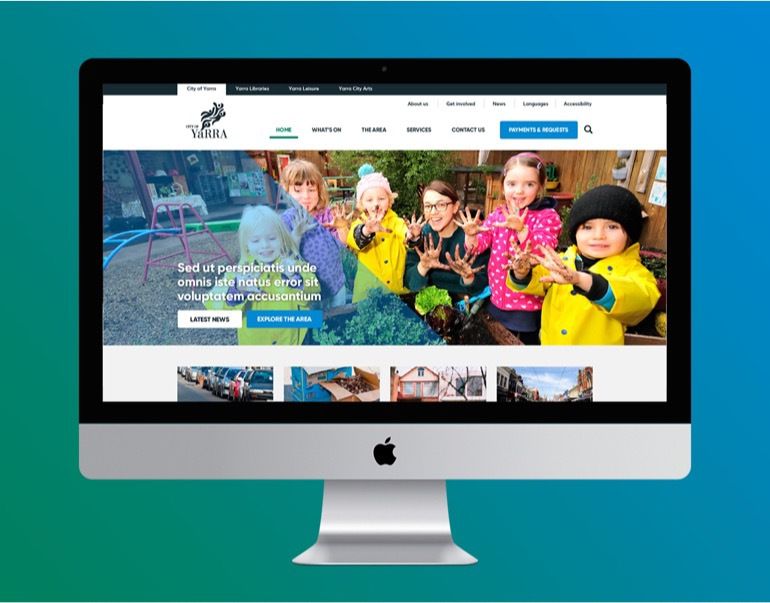
The project was successfully handed over to City of Yarra developers for the build stage, with comprehensive design specifications and rationale that would guide implementation and future iterations. The strategic framework we created provided the council with tools to make informed decisions as they continued developing their digital presence.
Reflection
This project reinforced critical lessons about strategic design for government and the business case for proper discovery investment.
First, investing in discovery is a strategic decision that pays dividends. The temptation in council projects is often to rush to solutions – consolidate everything, simplify the navigation, make it look modern. But without truly understanding the breadth of user needs, you risk creating something that serves the average user well but fails the edges. I had to make the strategic case for discovery investment, articulating how it would reduce risk, prevent costly rework, and ensure the solution actually served community needs. This required translating user research value into language council executives understood: risk mitigation, cost avoidance, community outcomes.
Second, the edges matter in local government, and this has strategic implications. Unlike commercial products where you can optimise for your core market, councils must serve everyone. The person who struggles with English, the elderly resident who isn't digitally confident, the small business owner navigating complex regulations – these aren't edge cases in Yarra, they're the community. Designing for the edges first meant the system worked brilliantly for everyone, but it also meant the council could genuinely claim to provide equitable digital services. This is both a design principle and a democratic principle.
Third, designing scalable information architecture proved particularly valuable strategically. Rather than creating something rigid that would break as services evolved, we built flexibility into the structure. This meant thinking beyond the immediate redesign to how the council's digital presence would need to adapt over coming years. Good government digital infrastructure should last a decade, not just satisfy immediate needs. The scalability we designed in wasn't gold-plating – it was strategic investment that would save the council from expensive redesigns as their services evolved.
Fourth, the workshop process with diverse stakeholders – from front-line staff to department heads to community representatives – created buy-in and surfaced insights we wouldn't have found through analytics alone. People who work in council services every day have invaluable knowledge about where systems fail and what residents actually need. Making space for that knowledge shaped a better solution, but it also built internal support for the project. Strategic design in government contexts requires managing organisational change, not just creating good user experiences.
Fifth, capacity building is strategic, not just nice-to-have. We deliberately worked to build the council's understanding of user-centred design principles. Through collaborative workshops and involving council staff in research and testing, we helped them develop capability they'd need to maintain and evolve the platform. This knowledge transfer meant our strategic approach could continue influencing decisions long after we left.
Finally, this project demonstrated that digital transformation in government is fundamentally about service delivery strategy, not just technology or user experience. How councils deliver services digitally affects who can access those services, which in turn affects equity and democratic participation. The strategic decisions we made – prioritising accessibility, designing for diversity, building scalability – weren't just design choices, they were choices about what kind of council Yarra wanted to be and how it would serve its community in an increasingly digital age.
The framework we created gave City of Yarra the tools to continue evolving their digital presence strategically, making informed decisions about new services, changing priorities, and emerging community needs. That's the mark of strategic design: creating not just solutions, but capability.