Newsletter
I occasionally send out short, thoughtful notes about UX, leadership, and the future of digital. No fluff. No spam.
I'm Ben Tollady — a strategic UX consultant and design leader based in Melbourne. I've spent 25 years in design across almost every context it exists in: junior designer, freelancer, agency founder, enterprise design leader. I work independently through tollady.com, helping founders and product leads apply senior design thinking to real problems, and coaching designers, agency founders, and in-house design leaders who want a straight-talking outside perspective.
If you're here to work with me, or to find someone who's been where you are — you're in the right place.
Great design outcomes start with strong teams and clear thinking. I bring a collaborative, direct leadership style grounded in empathy, strategy, and a healthy impatience for process that exists for its own sake. I believe in clarity over chaos, autonomy over approval gates, and practical action over perfection theatre.
Throughout my career I've learned that great design leadership isn't just about craft — it's about influence, vision, and the ability to tell a story that moves people. Whether founding a UX agency, driving self-service transformation at Origin, or reshaping design capability at Telstra, my approach has always centred on the same things: aligning teams around a shared vision, using storytelling to shift mindsets, driving genuine collaboration across product, design and engineering, and building environments where designers can do their best work.
I also build with AI tools daily, write code, and ship my own products — so when we talk about what's changing in the industry, I'm not speculating.
Born just outside Oxford in the summer of 1975, I grew up in a creative household – my dad was an architect and my mother a teacher. Art, design and music shaped my early years. At school, I gravitated towards Art and CDT (Craft, Design and Technology), drawn to technical drawing and the tactile process of making things from wood, metal and plastics. Outside the classroom, I spent most of my free time playing drums in bands. But it was a visit with my dad to the Central Saint Martins grad fair that really solidified my interest in design. Seeing the 3D renderings and models created by students sparked something in me – I was fascinated by the ability to communicate and bring ideas to life through design, particularly the way these renderings could help you imagine products that didn't yet exist.
After completing a foundational Art & Design course, I went on to study Industrial Design & Technology at Loughborough University, immersing myself in form, function, ergonomics and user-centred thinking. After graduating in 1997, I started my career in automotive interior trim design, working on projects like the new Mini for suppliers to BMW whilst continuing to play gigs across Oxfordshire and London in the evenings. By 1999, the urge to see more of the world became irresistible, and I left my job to travel through India, Southeast Asia, Australia, and New Zealand.
When I returned to London, I pivoted into digital design. It was the early 2000s – a pioneering time for the web – and I landed a role at Nettec Plc, a digital agency just off Oxford Street. There, I learned from some of the best designers of the era, working on projects for brands like Coca-Cola, Reuters and Dyson, experimenting with what digital experiences could be. It was exhilarating work, but after two years, wanderlust struck again. In 2001, I set off for South America, before eventually returning to London where I worked as a freelancer for clients including Marks & Spencer and The British Museum.
It was during this period in London that I met my wife, Amanda. We decided to move to her hometown of Melbourne at the end of 2003. My first role there was designing web and Flash projects for cinematic releases at Madman Entertainment, working alongside a talented team of like-minded young creatives.
I have fond memories of this period in my career – the web standards movement was in full swing, and I immersed myself in meetups and seminal books like Jeffrey Zeldman's "Designing with Web Standards" and Andy Budd's "CSS Mastery". It was a pioneering time with an active, supportive community all learning and experimenting together.
While I loved the team at Madman and the work was engaging, I needed a bigger challenge. After a couple of years, I moved to Ingena, a small but mighty digital consulting firm where I managed a team of designers working on experience design and digital transformation projects – before the term "UX" was officially coined – for major Australian organisations like Telstra, National Australia Bank and Australia Post. My title was 'Usability Specialist', a reminder of how young the field still was.
By 2008, the benefits of user-centred design were starting to be more widely understood, and the field of "UX" was beginning to gain real traction. My passion for design thinking helped me see an opportunity. At the time, most agencies in Australia were either web design shops or tech consultancies – very few specialised purely in user experience.
Inspired by pioneering companies like Clearleft and Adaptive Path, I wanted to build a business that put research, usability and accessibility at the heart of digital design. With our laptops set up at my kitchen table, an ex-colleague and I co-founded Thirst Studios.
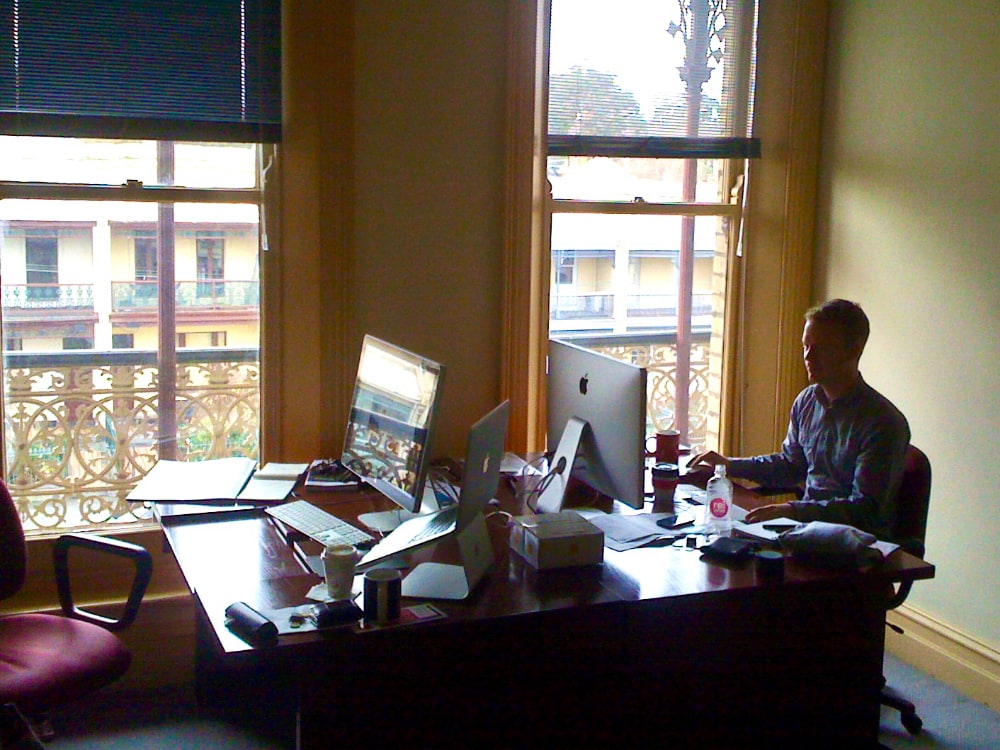
From the beginning, I knew that our success depended on more than just good design – it was about delivering results, building trust, creating great partnerships and communicating clearly. Clients needed to see the impact of great UX, not just be told about it. We positioned Thirst as a strategic partner rather than a design vendor, and we quickly developed a reputation for high-quality, thoughtful human-centred solutions. I'm particularly proud that we became a certified B Corp, embedding purpose-driven design into our DNA. Over ten years, the agency grew to a team of 15 and became known as one of Australia's most respected UX consultancies, working with clients across government, healthcare, and education.
Beyond client work, it was important for me to contribute to the growing UX community. We launched UXMAS, an internationally recognised UX advent calendar that brought together thought leaders to share their insights. I spoke at conferences like UX Australia and UX New Zealand, and founded and curated the Melbourne Geek Night meetup, helping to connect designers from across the industry.
I was immensely proud of what we'd created with Thirst Studios, but by 2018 I was ready for a new challenge. After a decade of agency life, I wanted to experience working in-house – to focus on a single product over an extended period, making iterative improvements and optimising at scale rather than moving from project to project.
I joined Origin Energy as Experience Design Director with a clear mandate: build the Experience Design practice from scratch. Working alongside the Head of Design, we built and scaled a team across UX, UI, content, research and optimisation. I led the service side – a team of eight UX designers embedded across eight squads responsible for Origin's customer-facing app and authenticated web experience.
The work delivered measurable impact. We increased digital engagement from 14.2% to 31.6%, designed and launched what became Australia's #1-rated energy app (achieving 4.3 stars in the Apple App Store and 4.7 on Google Play), and delivered transformational innovations including a world-first OCR meter-reading workflow that reduced manual calls by 50,000 per month. The app won Silver at the 2020 Melbourne Design Awards.
Beyond the tangible outcomes, those years at Origin taught me invaluable lessons about building design capability at scale, operating simultaneously at multiple altitudes – from tactical interaction design to strategic platform thinking – and creating the conditions for great teams to do their best work. You can read more about this work in my Origin Energy App and OCR Meter Reading case studies.
In 2020, I joined Telstra to lead UX for Telstra Energy, an ambitious new venture that would see Australia's largest telecommunications company enter the energy retail market with a climate-positive offering. Working in close collaboration with product, service design and engineering, we developed the product strategy and experience vision for integrating energy retail into Telstra's existing digital ecosystem. The project demanded extensive stakeholder navigation across a complex organisation and a delicate balance between ambitious vision and technical feasibility. Unfortunately, external factors – including global energy market disruption – led to the project being paused indefinitely in 2023. You can read more in the Telstra Energy case study.
When Telstra Energy was discontinued, I transitioned into the role of Head of Digital UX Design (Chapter Lead) for digital sales, leading a team of 30+ designers across multiple missions and focus areas. This role gave me the opportunity to shape design at genuine scale, building capability and creating customer experiences across one of Australia's most complex digital ecosystems.
I work with founders and product leads who need senior design capability without a full-time hire, and with designers, agency founders, and in-house design leaders who want an honest outside perspective from someone who's operated at both ends of the industry.
If that sounds like what you need, I'd love to hear from you.